
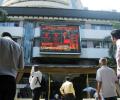
Investors became poorer by over Rs 4.47 lakh crore on Friday as markets faced severe drubbing, mirroring weak trends in global equities. The 30-share BSE benchmark dived 866.65 points or 1.56 per cent to settle at 54,835.58. During the day, it tumbled 1,115.48 points or 2 per cent to 54,586.75.

The failure of SVB was due to idiosyncratic reasons, but shows how higher rates can expose fault lines in unforeseen places, observes Neelkanth Mishra.

For rest of the year, the issue is largely going to be the balance between growth rates and macro stability versus interest rates, says Sankaran Naren.

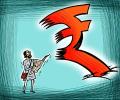
The rupee plunged 58 paise to close at an all-time low of 81.67 (provisional) against the US dollar on Monday as the strengthening of the American currency overseas and risk-averse sentiment among investors weighed on the local unit. Moreover, escalation of geopolitical risks due to conflict in Ukraine, a negative trend in domestic equities and significant foreign fund outflows sapped investor appetite, forex traders said. At the interbank foreign exchange market, the local currency opened at 81.47, then fell further to close at an all-time low of 81.67 against the American currency, registering a decline of 58 paise over its previous close.

Asia to stay flat in 2017. India is better-placed given its low export dependence and it should outperform Asian peers this year says Mixo Das, India strategist for financial major Nomura

Rising crude oil prices, traction in China equities and inflation concerns back home are casting a shadow on the Indian equity markets in the short term, believe analysts at Jefferies. They said this could see the markets remaining range-bound in the near term before the next leg up.
Government bonds yields are likely to trade in a range, owing to profit booking.

Stock markets will focus on global trends for further direction in this holiday-shortened week as the earnings season is largely over, analysts said. Trade experts expect the key benchmark indices to move sideways as investors are trying to decode the impact of rising inflation on foreign portfolio investments. Inflation data released by the US and China last week have fanned fears of earlier than expected rate hike and boosted US bond yields.

Equity investors have become poorer by more than Rs 18.74 lakh crore as the market continued to remain bearish for the fifth session on the trot on Thursday. The 30-share BSE Sensex tumbled 1,158.08 points or 2.14 per cent to end below the 53,000-level at 52,930.31 points on Thursday. Markets have been falling for five straight sessions and the BSE benchmark has tumbled 2,771.92 points or 4.97 per cent during this period.

Continuing its heavy selling spree for the eighth consecutive month, foreign investors pulled out nearly Rs 40,000 crore from the Indian equity market in May on fears of an aggressive rate hike by US Federal Reserve that dented investor sentiments. With this, net outflow by foreign portfolio investors (FPIs) from equities reached at Rs 1.69 lakh crore so far in 2022, data with depositories showed. Going ahead, FPI flows will remain volatile in the emerging markets on account of rising geo-political risk, rising inflation, tightening of monetary policy by central banks, among others, Shrikant Chouhan, Head - Equity Research (Retail), Kotak Securities said.

Jim Rogers, chairman of Rogers Holdings, tells Puneet Wadhwa that the US bond market that hit bottom in 1981 and has been in a bull-run since then, is coming to an end.

Investor wealth slumped by a whopping Rs 5.3 lakh crore on Friday as the benchmark BSE Sensex crashed more than 1,900 points to post its biggest single-day fall in nearly ten months. At the close of trade, the total market capitalisation of BSE-listed companies eroded by Rs 5,37,375.94 crore to Rs 2,00,81,095.73 crore. The total market capitalisation of these companies stood at Rs 2,06,18,471.67 crore on February 25.

Equity benchmark BSE Sensex closed at an all-time high of 62,272.68 on Thursday, tracking a firm trend in global markets after the US Fed minutes indicated a slower pace of rate increase that bolstered investors' sentiment. Extending its rally to the third straight day, the 30-share BSE benchmark rallied 762.10 points or 1.24 per cent to settle at 62,272.68, its record closing peak. During the day, it jumped 901.75 points or 1.46 per cent to its lifetime high of 62,412.33.he broader NSE Nifty gained 216.85 points or 1.19 per cent to end at 18,484.10.

Markets suffered after other Asian indices closed in the red, tracking record-breaking losses at the Wall Street overnight.
Investors need to understand and keep in mind how interest rates and the stock markets are related in order to make informed decisions.

The correction seen in the stock markets thus far is insufficient and there are significant downside risks, given the way macroeconomic data is shaping up, a Nomura equity strategist said on Thursday. "The markets are trying to look through the current stress we see in the macros. There are potential risks to the market. "Our estimates assume no major impact on growth and earnings. "The market should have been at least 5 per cent lower than it is now.

'Investors need to be stock specific and should not rush to buy stocks at the current levels.'

Days after JP Morgan announced the inclusion of government bonds in its emerging market (EM) bond index, a host of banks and other financial institutions (FIs) are set to tap the debt market. They plan to raise Rs 18,000 crore by issuing non-convertible debentures (NCDs) and bonds. National Bank for Agriculture and Rural Development (Nabard) plans to raise up to Rs 3,000 crore via five-year social impact bonds on Tuesday, the first of its kind in India.

By taking the mutual fund route, investors can take exposure to gilts with small amounts. Over a decade or more, returns from these funds tend to be sound.

Investor wealth surged Rs 602,001.9 crore in two days of market rally which was supported by positive global cues. The 30-share BSE index on Tuesday closed at 50,136.58, an increase of 1,128.08 points or 2.30 per cent. During the day, it gained 1,259.95 points to touch 50,268.45. On Friday, the benchmark had closed 568.38 points higher. Markets were closed on Monday for Holi. Driven by the rally, the market capitalisation of BSE-listed companies soared Rs 602,001.9 crore to Rs 2,04,77,472.33 crore in two trading days.

'One can start accumulating economy driven stocks in the next few months with a two-three year view.'
Equity investors became poorer by over Rs 8 lakh crore in five days of market plunge. The BSE benchmark has lost 2,062.99 points or 4 per cent in five trading sessions. On Thursday, the 30-share BSE benchmark tanked 585.10 points or 1.17 per cent to close at 49,216.52. Following the bearish trend, the market capitalisation of BSE-listed companies declined by Rs 804,216.71 crore to Rs 2,01,22,436.75 crore in five days.

'Investors with higher risk appetite and longer horizon (more than one year) can invest in longer-duration funds like corporate bond funds, long-duration funds and gilt funds for maximum gain.'

Investors' wealth has jumped by a massive Rs 9.41 lakh crore during three successive days of gains in the domestic equity market. The Sensex and the Nifty continued their upward journey for the third straight session on Wednesday, as the BSE benchmark surged nearly 1,148 points to breach the 51,000-level and the NSE benchmark index recaptured the 15,200-mark by rising 326.5 points. At the closing bell, the 30-share Sensex was up 1,147.76 points or 2.28 per cent at 51,444.65, the biggest single-day rise since February 2.
The yield on the 10-year bond may fall to 8.70 per cent due to FII flows in debt.

'Slower-than-anticipated recovery can be a bigger risk this time than a liquidity-driven event -- at least for India.'

According to currency dealers, any sharp movement in the rupee might result in the Reserve Bank of India intervening in the foreign exchange market.
'There is a weak link between the economy and the stock market.'

FPIs have turned net sellers in 2022 after being net buyers in the last three years.

'One way of doing this could be offering credit guarantee to the banks, say 10 per cent, for fresh loans given to micro, small and medium enterprises,' observes Tamal Bandyopadhyay.

The rupee's strength against its competitor could come to haunt exporters.

The most preferred CoCo bonds are those through which banks raise their additional Tier-I capital.

'Gold could benefit from the resulting risk aversion, as happened last year.'

Moody's said the negative outlook reflected uncertainty over the refinancing of Macrotech's (formerly Lodha Developers) upcoming debt maturities.

Fitch Ratings on Friday said it has revised the outlook on India's sovereign rating to 'stable' from 'negative' as downside risks to medium-term growth have diminished on rapid economic recovery. Fitch Ratings kept the rating unchanged at 'BBB-'.

'Rate cut should reiterate RBI's commitment in providing confidence to consumers and small business.'
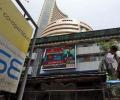
The stock exchange BSE has called off the merger of its unit at the Gujarat International Finance Tec-City International Financial Services Centre (GIFT IFSC), India International Exchange (India INX), with NSE International Exchange (NSE IX), a similar unit floated by rival National Stock Exchange (NSE), according to sources familiar with the development. BSE and NSE had been in discussions for the merger for over a year, but it has yielded no results, they said.

Assume that the rupee will trend lower over the next 10 years as India increases overseas sovereign exposures, and your long-term asset allocation should be geared to deal with this trend, suggests Devangshu Datta

In May 2014, FIIs were net buyers by Rs 20,225 crore (Rs 202.25 billion).

'India's fundamentals are a lot better (than those of other emerging market economies).' 'India will suffer (witness a fall in its stock market) what I call the second order effect.' 'And the second order will happen when these funds (belonging to macro and hedge fund investors and which have leveraged Japanese yen-carry trades), because they lose money elsewhere as lot of their positions were financed by borrowing Japanese yen, will have to book profits in investment destinations where they are making money, including in markets like India.' 'They (these investors) will have to effectively sell in countries like India and which is the consequence (the crash in equity markets) that Indian markets might see.'
